Apps · the app layer
Real apps,
complete loops.
A platform is only as convincing as the apps that ship on it. Micro OS includes a vocabulary trainer with a real review schedule, a settings surface wired to host APIs, and the smallest possible state demo.
momo · a vocabulary trainer
Not a mockup: a multi-user study app with a per-word Ebbinghaus schedule and a four-step review loop.
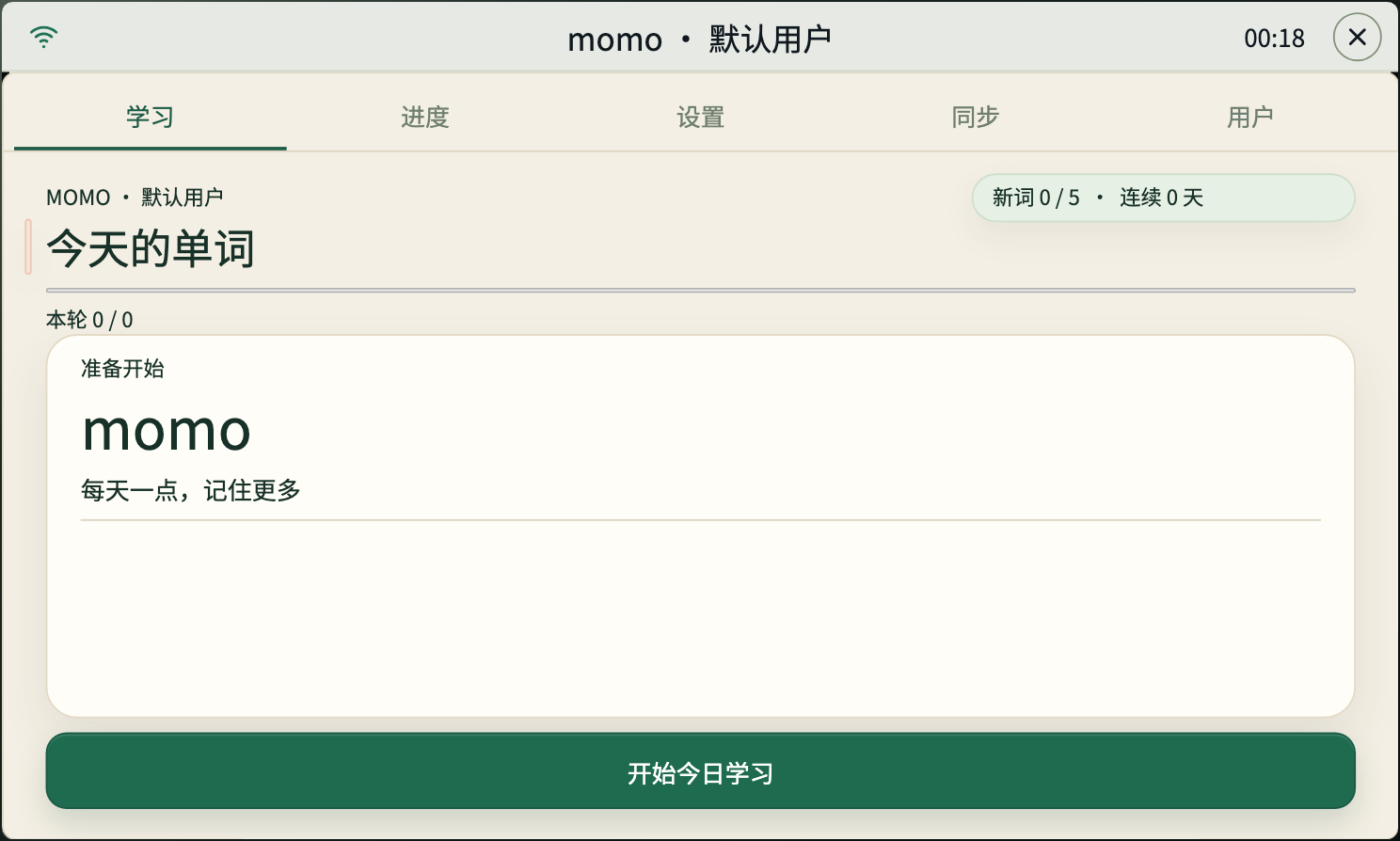
momo is written in the same restricted TypeScript as everything else. It keeps its state in kv, its per-user configuration in config, its audio and dictionary calls behind host APIs, and its layout on a static UI tree.
The study flow reveals one layer at a time. A wrong answer at stages 0–2 advances to the next hint without changing the memory stage; a wrong answer at stage 3 demotes the word and puts it back in the round immediately.
The schedule survives a page reload on the Web, an app switch on macOS and a reboot on the ESP32. That is the difference between a demo and an app.
| Stage | Screen | What you see |
|---|---|---|
| 0 · Listen | Hear the word, no spelling shown | 认识 / 不认识 |
| 1 · Spell | The word plus an IPA hint | 认识 / 不认识 |
| 2 · Cloze | An example sentence with the word removed | 认识 / 不认识 |
| 3 · Define | Word, sentence, definition and translation | Grade and advance |
Nine intervals
Each word advances independently through a fixed schedule:
No global "day N" counter. Every word carries its own last timestamp and stage, so a missed day only makes that word due.
Five local users
One install, up to five profiles. Every KV and config key is namespaced (u2:–u5:; the default user keeps the legacy unprefixed keys). Switching users stops audio, clears the current study session, and discards late sync responses from the previous account.
The active profile is shown in the OS app bar through os.setTitle, and the last active user is restored on launch.
Maimemo sync
On macOS, the sync tab imports the active account's real today_items queue through the native HTTP bridge, then enriches words with definitions and example sentences through net.lookupWords.
The token is per user. Sync is serialized: a second tap while a request is in flight only reports that a sync is already running, so a late response cannot overwrite another user's namespace.
Counter & Settings
The smallest state demo, and a settings surface wired to real host capabilities.
Counter
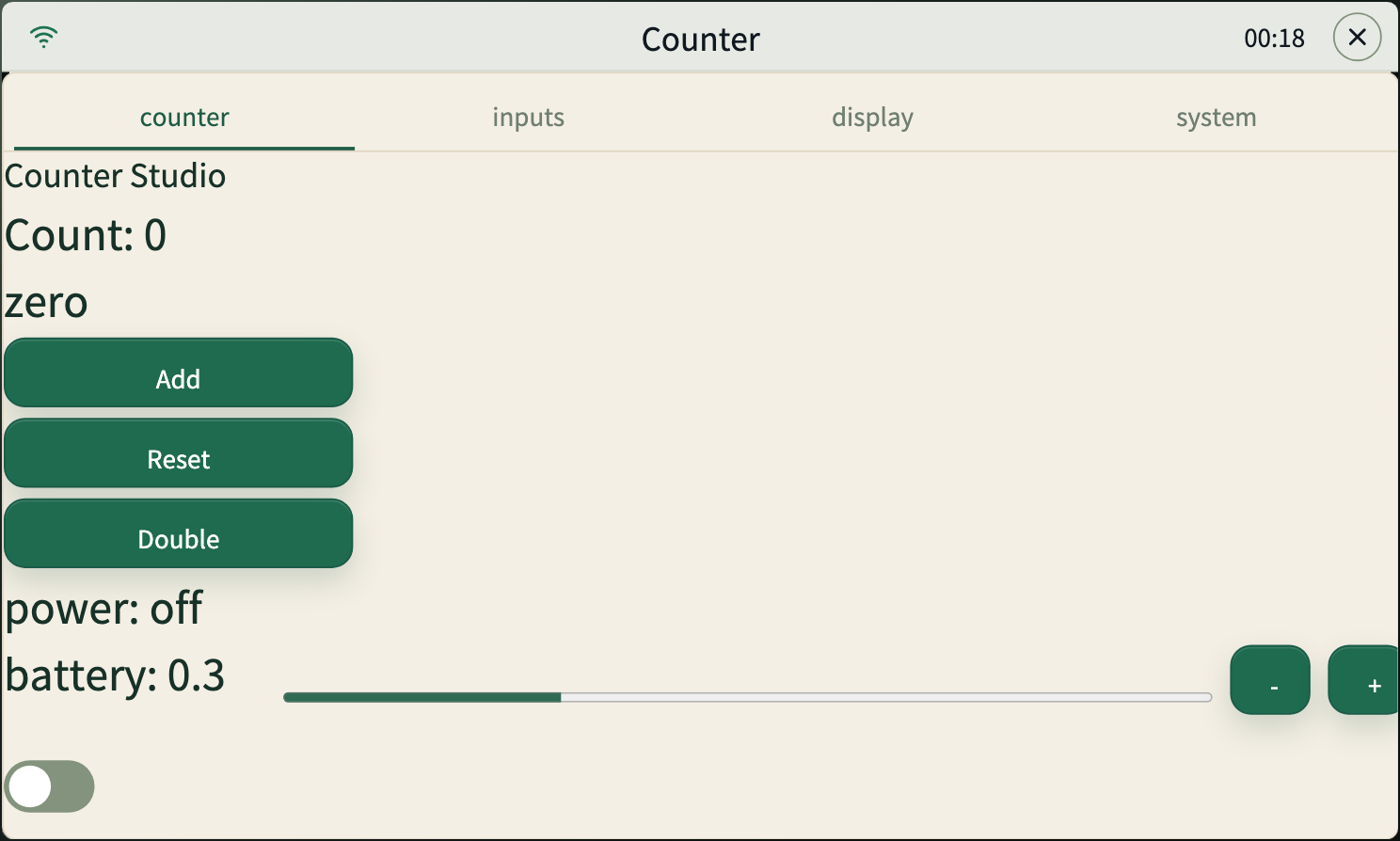
Arithmetic, conditionals, a text input, a switch, a progress bar and three buttons. It is the end-to-end test app: compile, load, click twice, assert Count: 2 — through the native renderer and through Chromium.
Settings
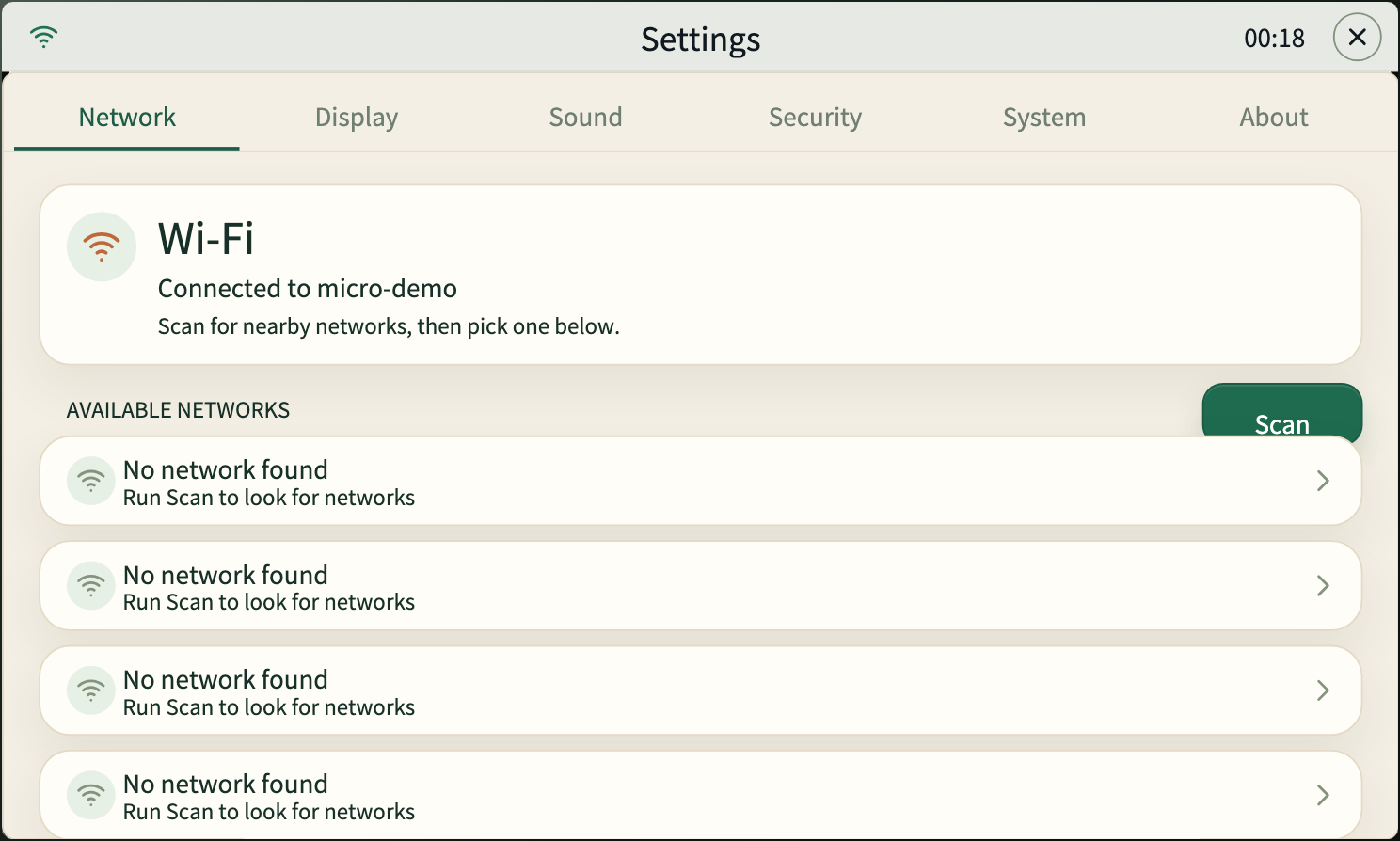
Six root tabs: Network, Display, Sound, Security, System, About. Brightness, Wi-Fi scan/connect, speech rate and storage status are wired to host APIs; anything the OS does not expose yet is a dimmed "coming soon" row, not a dead control.
Install without reflashing
Compiled apps are data. Drop them on the card; the launcher picks them up on the next Home boot.
/sdcard
└── apps
    ├── notes.mbc
    ├── timer.mbc
    └── studio.mbc
On the Web and macOS hosts the card is simulated; on the device it is the removable TF card. Built-in apps always win an id collision, malformed images are skipped, and there are eight slots total including the built-ins.
Policy
- Scan happens before every Home boot once the card was mounted at startup.
- A card inserted later needs a reboot to be recognized.
- No card:
storage.available()is false and/appsis ignored. - No installer UI, no signature check, no marketplace in this slice.
The language is the contract
An allow-list, not a dialect. The compiler says no early, with a source location.
Allowed
const/let, numbers, strings, booleans,null- Arithmetic, comparisons, template literals
if/else,while, arrow handlers and bindingsstate,bind,ui.mountand the widget catalog- Declared host calls:
kv,config,storage,net,audio,clock,json,device,os
Rejected
- JSX, classes, general functions, async / await, promises
- Exceptions, runtime imports, arbitrary objects or arrays
- Spread, destructuring, computed properties
- Browser / Node globals and dynamic UI creation
- Any host call outside the manifest (
MTS002)